
How Much Does a Truck Cap Weigh? Aluminum vs Fiberglass vs Steel
In this guide
A truck cap can weigh anywhere from well under 100 lbs to several hundred pounds depending on its material, size, construction and accessories.
That difference matters.
The weight of your truck canopy, truck topper or camper shell counts toward your pickup's payload and can affect how much equipment, passengers and cargo you can safely carry.
If you're building a work truck, camping setup or overland vehicle, understanding truck cap weight should be part of the buying process.
Typical Truck Cap Weight by Material
There is no universal weight for each material, but these ranges provide a useful starting point:
|
Truck Cap Type |
Typical Approximate Weight |
Relative Weight |
|
Soft Truck Topper |
40–100 lbs |
Very Light |
|
Aluminum Truck Cap |
100–250+ lbs |
Light–Medium |
|
Fiberglass Truck Cap |
150–250+ lbs |
Medium |
|
Stainless / Steel Truck Cap |
200–350+ lbs |
Medium–Heavy |
|
Canopy Camper System |
300–500+ lbs |
Heavy |
Actual weights vary significantly by truck size, bed length, roof structure, doors, windows and accessories.
A full-size 6.5-foot canopy will generally weigh more than a comparable cap for a midsize 5-foot pickup.
Why Does Truck Cap Weight Matter?
Truck cap weight matters because it becomes permanent or semi-permanent weight carried by your pickup.
If your truck has a payload capacity of 1,500 lbs and your complete canopy installation weighs 250 lbs, you now have roughly 1,250 lbs remaining before accounting for other loads.
Those other loads may include:
-
Driver and passengers
-
Tools
-
Camping equipment
-
Rooftop tent
-
Roof rack
-
Bikes
-
Water
-
Fuel containers
-
Recovery gear
-
Cargo
This becomes especially important for heavily modified overland trucks.
How Much Does an Aluminum Truck Cap Weigh?
A modern aluminum truck cap will commonly fall somewhere around:
100–250+ lbs
depending on construction and vehicle size.
Light commercial aluminum toppers can be relatively simple and lightweight.
Premium aluminum truck canopies may weigh more because they include:
-
Reinforced roofs
-
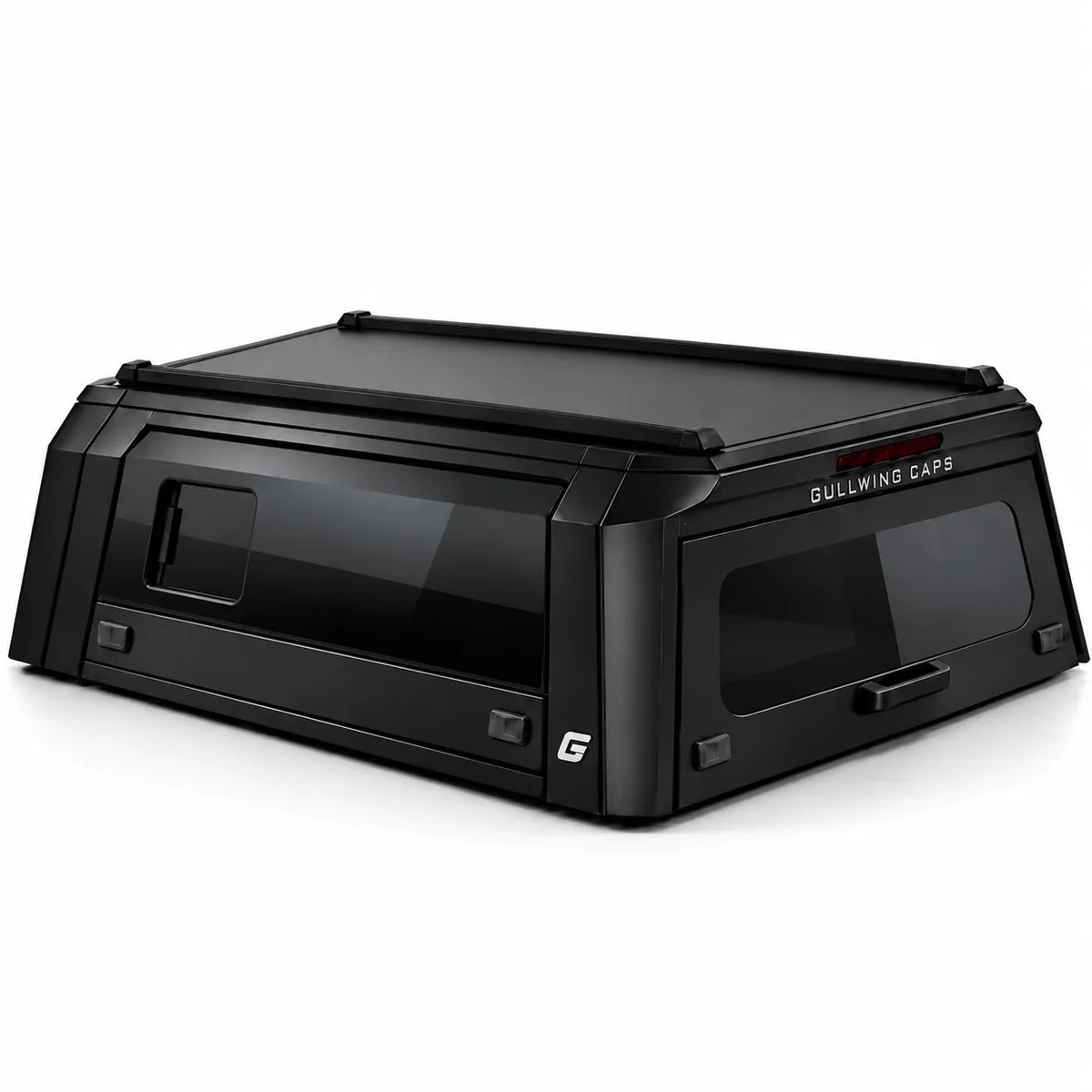
Large gullwing doors
-
Tempered glass
-
MOLLE panels
-
Roof rails
-
Heavy-duty locks
-
Gas struts
-
Structural reinforcement
That additional weight is not necessarily a disadvantage if it produces substantially more capability.
The more useful comparison is strength-to-weight ratio.
Why Aluminum Is Popular for Truck Caps
Aluminum is widely used for work and overland truck canopies because it offers a strong combination of:
-
Relatively low weight
-
Structural strength
-
Corrosion resistance
-
Roof-load capability
-
Accessory compatibility
A properly engineered aluminum truck cap can support significant loads while keeping overall canopy weight manageable.
This leaves more of the truck's payload available for passengers, equipment and cargo.
How Much Does a Fiberglass Truck Cap Weigh?
A typical fiberglass truck cap often weighs approximately:
150–250+ lbs
depending on the size and design.
Fiberglass truck toppers can become heavier when equipped with:
-
Thick molded shells
-
Large glass windows
-
Carpeted interiors
-
Roof reinforcement
-
Commercial doors
-
Roof racks
Fiberglass is particularly popular with buyers who prioritize a smooth, factory-style appearance.
Weight may be less important for a daily driver than for a truck carrying extensive camping or overland equipment.
How Much Does a Steel Truck Cap Weigh?
Steel and stainless steel truck caps are generally among the heavier rigid options.
A typical range may be approximately:
200–350+ lbs
depending on the truck and construction.
Steel provides excellent structural strength, but the material is denser than aluminum.
For a work truck, that may be an acceptable trade-off.
For an overland build where you are adding a rooftop tent, awning, water, recovery equipment and other accessories, the extra weight becomes more important.
Aluminum vs Steel Truck Cap Weight
This is where aluminum can offer a significant advantage.
Both materials can produce extremely strong truck canopies.
However, aluminum is much lighter by volume than steel.
That means an aluminum canopy can potentially provide substantial structural strength without adding as much total weight to the truck.
For example, if two truck cap systems provide similar functionality but one weighs 100 lbs less, that additional 100 lbs remains available for:
-
Passenger weight
-
Camping equipment
-
Water
-
Tools
-
Rooftop accessories
For payload-sensitive builds, that difference can matter.
Does a Heavier Truck Cap Mean It Is Stronger?
Not necessarily.
Weight alone does not determine strength.
Truck cap performance depends on:
-
Material
-
Material grade
-
Thickness
-
Structural design
-
Reinforcement
-
Welding
-
Fasteners
-
Roof structure
-
Mounting system
A heavier canopy can be stronger—but it can also simply be heavier.
The best way to compare products is to look at both total weight and published load capacity.
Truck Cap Weight vs Roof Load Capacity
These two numbers should not be confused.
Truck cap weight is how much the canopy itself weighs.
Roof load capacity is how much additional weight the roof is designed to carry.
For example:
Canopy weight: 200 lbs
Dynamic roof capacity: 500 lbs
The canopy itself weighs 200 lbs, while the roof may be designed to support up to 500 lbs under the manufacturer's specified dynamic conditions.
Both figures matter for different reasons.
Truck Cap Weight and Rooftop Tents
If you're planning a rooftop tent on a truck cap, weight becomes particularly important.
Consider this hypothetical setup:
|
Component |
Weight |
|
Truck cap |
200 lbs |
|
Rooftop tent |
165 lbs |
|
Crossbars |
35 lbs |
|
Awning |
40 lbs |
|
Recovery equipment |
30 lbs |
|
Total added vehicle weight |
470 lbs |
You have added nearly 500 lbs before passengers, food, water or other camping equipment.
This is why a lighter truck canopy can be valuable for overlanding.
Truck Cap Weight and Vehicle Payload
Your truck's payload rating should be treated separately from the canopy's roof capacity.
Payload generally includes weight added to the vehicle such as:
-
Truck cap
-
Passengers
-
Cargo
-
Rooftop tent
-
Accessories
-
Tools
You can normally find your truck's payload information on the vehicle's certification label or in manufacturer documentation.
Do not assume that because a truck cap can support a heavy rooftop tent, the vehicle itself has unlimited payload available.
Does Bed Length Affect Truck Cap Weight?
Yes.
A cap for an 8-foot pickup bed generally requires more material than one for a 5-foot bed.
Truck size also matters.
A full-size pickup canopy is usually wider and larger than a midsize truck canopy.
This means the same truck-cap model may have different weights depending on the application.
Do Windows Add Weight?
They can.
A sliding-window configuration includes:
-
Glass
-
Window frames
-
Tracks
-
Locks
-
Seals
A smooth aluminum panel may weigh differently from a full window assembly.
MOLLE panels and additional reinforcement can also change canopy weight.
This is why the manufacturer's weight for your specific configuration is more useful than a generic cap weight.
Do Truck Cap Accessories Count Toward Payload?
Yes.
Every accessory contributes additional weight.
Common additions include:
-
Crossbars
-
Roof platforms
-
Rooftop tents
-
Awnings
-
MOLLE accessories
-
Recovery boards
-
Interior shelving
-
Drawer systems
-
Solar panels
-
Toolboxes
A 200-lb canopy can quickly become a 400–500+ lb truck-cap system once fully equipped.
What Is the Best Truck Cap Material for Weight?
If low weight is the only objective, a soft topper is generally the lightest.
Among rigid, heavy-duty canopies, aluminum offers one of the best combinations of low weight and structural capability.
A simplified comparison looks like this:
Soft topper: Lightest, but least structural capability
Aluminum: Excellent strength-to-weight balance
Fiberglass: Moderate weight with strong styling advantages
Steel: High strength with greater weight
The best choice depends on what you need the truck cap to do.
Is a Lightweight Truck Cap Always Better?
No.
Removing weight is useful, but not if it compromises the features you actually need.
A contractor may prefer a heavier canopy with strong doors and secure storage.
An overlander may accept additional reinforcement to achieve higher roof-load capacity.
A daily driver may prefer fiberglass despite the weight because appearance is more important.
The goal is not necessarily to find the lightest truck topper.
It is to find the appropriate weight for the required capability.
Frequently Asked Questions
How much does a truck cap weigh?
Rigid truck caps commonly weigh somewhere between approximately 100 and 350+ lbs, while very light soft toppers and heavy camper systems can fall outside that range.
How much does an aluminum truck cap weigh?
Many aluminum truck caps fall roughly within the 100–250+ lb range, although size and construction vary.
How much does a fiberglass truck cap weigh?
Many fiberglass truck caps weigh approximately 150–250+ lbs, depending on vehicle size and options.
How much does a steel truck cap weigh?
Steel or stainless truck caps can commonly weigh around 200–350+ lbs, although individual models vary.
Does truck cap weight affect payload?
Yes. The canopy is added vehicle weight and therefore needs to be considered when calculating available payload.
Are aluminum truck caps lighter than steel?
Generally, yes. Aluminum's lower density allows manufacturers to build strong structures at lower overall weight than comparable steel construction.
Does a rooftop tent count toward payload?
Yes. The rooftop tent, rack and related accessories add weight to the vehicle.
How Much Should Your Truck Cap Weigh?
There is no ideal truck cap weight for every pickup.
A lighter canopy preserves vehicle payload.
A heavier canopy may provide additional structure, equipment or security.
When comparing a truck cap, truck canopy, truck topper or camper shell, look at more than the weight alone.
Compare:
Cap weight
Dynamic roof capacity
Static roof capacity
Construction material
Accessories
Vehicle payload
For work, camping and overlanding applications, a properly engineered aluminum truck cap can provide an excellent balance between weight and structural capability.
Explore GullWing Truck Caps
GullWing aluminum truck canopies are available in MOLLE Panel, Smooth Side and Sliding Window configurations for work, camping, overlanding and everyday use.
FAQ
Are aluminum truck caps lighter than steel truck caps?
Generally, yes. Aluminum has a much lower material density than steel and can provide excellent structural strength at a lower overall weight.
Does truck cap weight reduce vehicle payload?
Yes. The canopy becomes part of the weight carried by the vehicle and therefore uses some of the available payload.
Does a heavier truck cap mean it is stronger?
Not necessarily. Structural design, material grade, thickness, reinforcement and mounting all affect strength.
Do truck cap accessories add to payload?
Yes. Roof racks, tents, drawers, awnings, storage and other equipment all add weight to the truck.
Keep exploring.
More buying advice, installation help and care guides.