
Truck Cap Types Explained: Aluminum vs Steel vs Fiberglass Truck Canopies
In this guide
Truck Cap Types Explained: Aluminum vs Steel vs Fiberglass Truck Canopies
Choosing the right truck cap can completely change how you use your pickup truck. Whether you need secure storage for work tools, a weather-resistant truck canopy for camping, a lightweight truck topper for everyday use, or a heavy-duty platform capable of carrying a rooftop tent, the material and construction of your truck cap matter.
Truck caps are known by several names depending on where you live and how you use your truck. You may hear them called a truck topper, truck canopy, camper shell, pickup cap, truck shell, truck bed cap, truck bed canopy, or even a truck cover. In most cases, these terms describe a rigid or semi-rigid enclosure installed over the bed of a pickup truck. Major cap manufacturers themselves use several of these terms interchangeably.
However, not every truck canopy is built the same.
Today's truck owners can choose from several major construction types, including aluminum truck caps, stainless steel truck caps, fiberglass truck caps, ABS or composite truck canopies, and soft fabric truck toppers.
Each has advantages and trade-offs.
The right choice depends on how much weight you want to carry, whether you plan to install a rooftop tent, how important security is, the appearance you want, your budget, and whether your truck is being built for work, overlanding, camping, travel, or everyday driving.
Quick Truck Cap Comparison
|
Feature |
Aluminum Truck Cap |
Stainless Steel Truck Cap |
Fiberglass Truck Cap |
ABS / Composite Truck Cap |
Soft Truck Topper |
|
Best For |
Overlanding, work, camping & accessories |
Heavy-duty work & overlanding |
Everyday driving & recreation |
Lightweight everyday use |
Occasional & flexible use |
|
Construction |
Aluminum alloy |
Stainless steel |
Fiberglass composite |
ABS / composite |
Fabric + lightweight frame |
|
Relative Weight |
Light–Medium |
Medium–Heavy |
Medium–Heavy |
Light–Medium |
Very Light |
|
Strength-to-Weight |
Excellent |
Excellent |
Good |
Good |
Limited |
|
Roof Load Potential |
High on rated models |
High |
Moderate–High |
Model dependent |
Limited |
|
Rooftop Tent Compatibility |
Excellent on rated caps |
Excellent |
Model dependent |
Model dependent |
Usually limited |
|
Corrosion Resistance |
Excellent |
Excellent |
Excellent |
Excellent |
Hardware dependent |
|
Cargo Security |
High |
Very High |
High |
High |
Low–Moderate |
|
Paint Matching |
Available on some models |
Limited |
Excellent |
Available on some models |
Limited |
|
Accessory Integration |
Excellent |
Excellent |
Good |
Moderate |
Limited |
|
Customization |
Very High |
High |
High |
Moderate |
Low–Moderate |
|
Installation / Removal |
Moderate |
Moderate |
Moderate |
Moderate |
Easy |
|
Typical Price |
Mid–Premium |
Premium |
Mid–Premium |
Mid-range |
Entry–Mid |
|
Primary Advantage |
Strength + low weight + versatility |
Strength + security |
Styling + paint matching |
Lightweight molded design |
Flexibility + low weight |
Specifications vary significantly between manufacturers and individual truck cap models, so always check the manufacturer's published weight, roof-load and fitment specifications before purchasing.
1. Aluminum Truck Caps
An aluminum truck cap is one of the most versatile options for truck owners who want a strong structure without excessive weight.
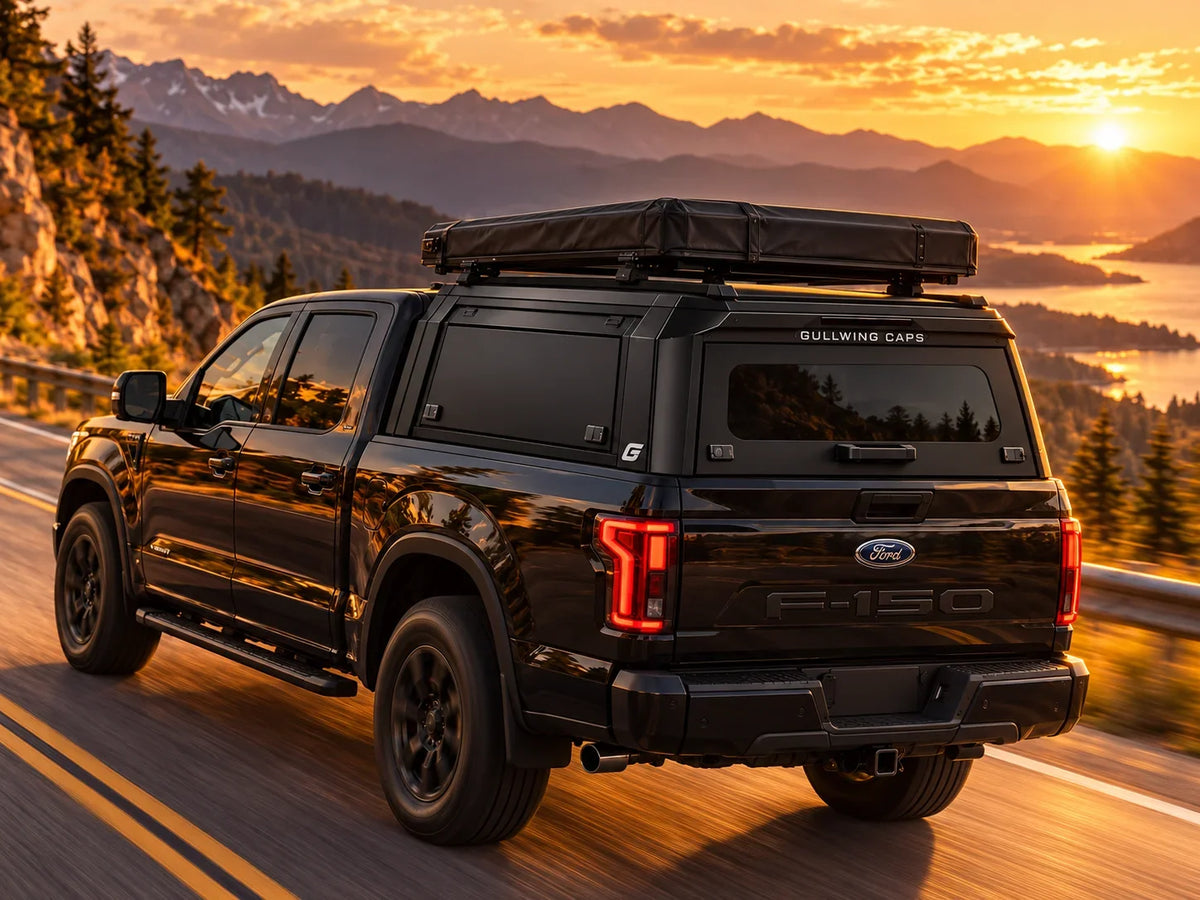
Modern aluminum truck canopies are very different from the basic commercial aluminum caps that many people associate with older work trucks. Premium aluminum truck caps can now feature gullwing doors, sliding windows, MOLLE panels, roof racks, crossbars, interior lighting, accessory rails, storage systems and rooftop-tent compatibility.
This makes aluminum especially popular for overland truck builds, contractors, outdoor enthusiasts, campers and truck owners who frequently carry equipment on the roof.
Aluminum provides an excellent strength-to-weight ratio and naturally resists rust. That can be particularly valuable in Canada, where trucks are exposed to rain, snow, road salt and changing temperatures.
Premium aluminum canopies can also be designed around significant roof loads. This is important if you intend to install a rooftop tent, kayak rack, ski rack, cargo basket, recovery equipment, awning or other roof-mounted accessories.
Advantages of an Aluminum Truck Canopy
Aluminum offers one of the strongest combinations of low weight, structural capability, corrosion resistance and accessory compatibility.
It is also particularly well suited to modular designs. Accessories can often be integrated directly into roof rails, MOLLE panels or predetermined mounting locations instead of requiring extensive modification after purchase.
For this reason, an aluminum truck bed canopy can work equally well as a commercial work cap during the week and an adventure-oriented truck topper on weekends.
Things to Consider
Aluminum can dent when subjected to a significant impact, and an uninsulated metal canopy can transfer heat and cold more readily than fiberglass.
Construction quality also varies dramatically. Aluminum thickness, alloy grade, weld quality, seals, hinges, hardware and internal reinforcement can all affect the finished product.
Two aluminum truck caps can therefore look similar while having very different structural specifications.
2. Stainless Steel Truck Caps
A stainless steel truck cap is another premium choice, particularly for buyers prioritizing structural strength, security and demanding off-road use.
Some modular overland truck caps use automotive-grade stainless steel rather than aluminum. Stainless steel can provide excellent structural durability but generally carries a weight penalty compared with an equivalent aluminum structure.
That does not necessarily make stainless steel better or worse. It represents a different engineering trade-off.
A stainless steel truck canopy can make sense for owners who prioritize heavy-duty construction, secure side doors, roof loads and modular accessories more highly than minimizing overall vehicle weight.
Stainless steel systems are commonly seen in the overlanding market, where roof tents, recovery equipment, camping accessories and exterior storage systems are frequently installed.
Aluminum vs Stainless Steel Truck Caps
This is one of the most important distinctions shoppers should understand.
Aluminum generally offers a better strength-to-weight balance, while stainless steel can provide substantial structural strength at a higher overall weight.
Actual performance depends much more on engineering than material alone. Panel thickness, reinforcement, fastening methods, welds and overall design all matter.
That is why buyers should compare published dynamic roof load, static roof load and total cap weight rather than choosing solely on the material name.
3. Fiberglass Truck Caps
A fiberglass truck cap remains one of the most common choices for everyday pickup trucks.
Fiberglass canopies are particularly popular among owners who want their truck topper to look like an extension of the factory vehicle rather than an aftermarket utility accessory.
They can often be ordered in colours designed to match the truck's factory paint, creating a clean OEM-style appearance.
Manufacturers position fiberglass caps for everyday use, recreation, camping, travel and secure cargo storage, while aluminum products are often more work- or utility-oriented.
Fiberglass truck caps can also incorporate sliding windows, screened windows, roof racks, interior carpeting, lighting and elevated roof designs.
Why Choose a Fiberglass Truck Topper?
The major advantage is appearance.
For someone primarily using their pickup as a daily driver, family vehicle, road-trip vehicle or recreational truck, a colour-matched fiberglass canopy can provide enclosed storage without giving the truck a commercial appearance.
Fiberglass also tends to provide better inherent insulation and sound characteristics than bare metal.
Fiberglass Truck Cap Considerations
Fiberglass caps are generally heavier than lightweight aluminum designs and can crack or chip following significant impacts.
Roof capacity can also vary considerably.
Some fiberglass truck caps are engineered specifically for roof racks and substantial loads, while others are designed primarily as cargo enclosures.
If you're planning to mount a rooftop tent on a truck cap, always verify the manufacturer's published static and dynamic roof ratings rather than assuming the shell can support it.
4. ABS and Composite Truck Canopies
A newer category includes ABS truck canopies and composite truck caps.
ABS is a thermoplastic material capable of being molded into smooth, lightweight shapes. Composite construction can also combine several different materials to achieve specific strength, weight, insulation or appearance characteristics.
This category can provide a middle ground between traditional fiberglass and metal truck caps.
ABS and composite truck toppers can offer good corrosion resistance because large sections of the canopy are non-metallic. They can also provide a modern molded appearance while potentially reducing weight compared with some fiberglass products.
However, the term composite truck cap is broad.
Different manufacturers use different materials and construction techniques, so buyers should compare the actual engineering specifications rather than assuming all composite canopies perform alike.
Pay particular attention to roof-load capacity, replacement-panel availability, mounting systems and accessory compatibility.
5. Soft Truck Toppers and Fabric Truck Covers
A soft truck topper is fundamentally different from a rigid aluminum, steel or fiberglass truck cap.
Soft toppers typically use a fabric enclosure supported by a lightweight folding or removable frame.
Their major advantage is flexibility.
Owners can often collapse or remove the topper when they need an open pickup bed and reinstall it when covered cargo space is required.
Modern fabric toppers can provide weather protection while weighing substantially less than most rigid truck canopies.
Manufacturers such as Bestop market soft truck toppers around folding/removable panels and relatively simple installation.
When Does a Soft Truck Topper Make Sense?
A soft topper can be a strong option for someone who only occasionally needs enclosed cargo space.
It can work well for road trips, recreational gear, camping equipment or owners who frequently switch between an open bed and covered bed.
The trade-off is security and structural capability.
Fabric cannot provide the same physical barrier as a rigid metal or fiberglass truck cap, and most soft toppers are not intended to carry heavy roof-mounted loads.
Truck Cap vs Tonneau Cover: What's the Difference?
One important distinction involves the phrase truck cover.
Consumers sometimes use “truck cover” when searching for both truck caps and tonneau covers, but these are different products.
A tonneau cover generally covers the truck bed at approximately bed-rail height.
A truck cap or truck canopy extends upward, usually toward cab height or higher, creating considerably more enclosed cargo volume.
A tonneau cover can be ideal if your priority is maintaining a low-profile bed enclosure.
A truck topper is generally better when you need vertical storage space, want to transport large equipment, need side access, plan to camp inside the bed, or want to carry equipment above the canopy.
This distinction is worth considering before deciding which type of pickup truck bed cover is best for you.
What Is the Best Truck Cap for Camping?
For camping, the most important factors are usually ventilation, roof capacity, weather protection, interior space, windows, lighting and accessory compatibility.
Aluminum and stainless steel canopies are particularly attractive for more advanced overland builds because they can support modular accessories, MOLLE storage, awnings, racks and, when properly rated, rooftop tents.
Fiberglass truck toppers can also make excellent camping setups, particularly when sleeping inside the truck bed rather than using a rooftop tent.
For interior sleeping, features such as screened sliding windows and ventilation may actually matter more than maximum roof capacity.
Your ideal camping truck cap therefore depends on whether you plan to sleep inside the truck bed or above it in a rooftop tent.
What Is the Best Truck Canopy for Contractors?
Contractors should typically prioritize security, durability, organization and accessibility.
An aluminum work truck canopy can provide side-access doors, shelving, MOLLE systems, ladder racks, tool organization and substantial cargo protection while keeping weight relatively manageable.
Stainless steel truck caps can also be excellent for commercial use when maximum structural durability and security are priorities.
Fiberglass may still work for lighter commercial applications, but buyers who regularly access tools throughout the day often benefit from large gullwing side doors rather than conventional sliding windows.
For a work truck, pay close attention to door opening size, lock quality, accessory mounting, roof capacity and replacement-parts availability.
What Is the Best Truck Cap for a Rooftop Tent?
Never select a truck canopy for a rooftop tent based solely on material.
Instead, check two specifications:
Dynamic roof load is the amount of roof weight the cap is designed to support while the vehicle is moving.
Static roof load is the amount it can support while parked.
The static rating is particularly important when a rooftop tent will hold multiple occupants, while dynamic capacity matters when driving with the tent installed.
A properly engineered aluminum or stainless steel canopy can offer substantial roof capacity, but individual products differ significantly.
Fiberglass truck caps may also support rooftop tents when specifically rated by the manufacturer.
Always consider the lowest rated component in the complete system, including the truck, canopy, rack, crossbars, mounting hardware and rooftop tent.
What Should You Look for When Buying a Truck Cap?
Material matters, but it should not be the only factor.
A strong truck-cap buying decision should consider your exact year, make, model and bed length, followed by how you actually intend to use the vehicle.
A customer building an overland Tacoma has very different requirements from a contractor using an F-150, or a family using a Silverado for road trips.
Important factors include construction material, cap weight, aluminum thickness, dynamic roof capacity, static roof capacity, window configuration, ventilation, locking systems, water resistance, accessory mounting, replacement parts, warranty, installation requirements and overall price.
Fitment is particularly important because most truck caps are engineered around specific vehicle generations and bed lengths. Manufacturers similarly advise customers to consider truck configuration, windows, roof-rack needs, cargo requirements and intended use when selecting a cap.
Aluminum vs Fiberglass vs Steel: Which Truck Cap Is Best?
There is no single material that is ideal for every truck owner.
For someone prioritizing strength-to-weight ratio, roof capacity, corrosion resistance and accessory integration, a premium aluminum truck cap can be particularly attractive.
For buyers who prioritize heavy-duty structural strength and security, stainless steel deserves consideration.
For customers who prioritize factory styling, paint matching and everyday comfort, fiberglass remains an excellent truck topper option.
ABS and composite canopies occupy an increasingly useful middle ground, while soft toppers provide maximum removability and minimum weight.
The important question is not simply:
“What is the best truck cap?”
It is:
“What is the best truck cap for the way I use my truck?”
Why Aluminum Truck Caps Are Becoming Popular for Overlanding
Modern overlanding has changed what many truck owners expect from a canopy.
A truck cap is no longer simply a shell protecting items in the bed.
Today, it can become the structural foundation for an entire vehicle setup.
An aluminum overland canopy can potentially support a rooftop tent, awning, recovery boards, fuel or water storage, MOLLE accessories, roof racks, camping gear, tools, bicycles and other equipment, depending on its rated capacities.
Because aluminum combines corrosion resistance with relatively low weight, manufacturers can engineer substantial structures without imposing the same weight penalty as some heavier materials.
That is particularly relevant for truck owners already carrying camping gear, passengers, bumpers, racks or other accessories because every modification contributes toward the vehicle's payload.
Frequently Asked Questions About Truck Caps
Is a truck cap the same as a truck topper?
Generally, yes. Truck cap, truck topper, camper shell, pickup cap and truck shell are commonly used to describe the same general category of pickup-bed enclosure. Terminology varies by region.
Is a truck canopy the same as a truck cap?
Usually. In Canada and some other markets, truck canopy is commonly used for what may be called a truck cap, topper or camper shell elsewhere.
What is the lightest type of truck topper?
Soft fabric toppers are generally the lightest category. Among rigid truck caps, weight depends considerably on material, dimensions and engineering.
Are aluminum truck caps better than fiberglass?
They serve different priorities. Aluminum can provide excellent strength-to-weight performance and accessory integration, while fiberglass is often preferred for smooth styling and factory paint matching.
Do aluminum truck caps rust?
Aluminum does not rust like ordinary carbon steel, although corrosion can still occur under certain conditions. Proper coatings, compatible fasteners and routine maintenance remain important.
Can you put a rooftop tent on a truck cap?
Only when the truck cap and mounting system are rated for the load. Check both dynamic and static load ratings before installing a rooftop tent.
Are truck caps waterproof?
Truck caps should be considered weather-resistant rather than absolutely waterproof. Seals, installation quality, tailgate design, openings and weather conditions can affect water intrusion.
Are truck caps worth it?
A truck cap can be valuable if you regularly need additional cargo security, weather protection, vertical storage, camping capability or organization. The benefit depends on how frequently you use those features.
Find the Right Truck Cap for Your Pickup
Whether you call it a truck cap, truck canopy, truck topper, camper shell, pickup cap, truck shell or truck cover, the right product should fit both your truck and the way you intend to use it.
Before choosing between aluminum, stainless steel, fiberglass, composite or fabric construction, consider the entire system: weight, roof capacity, security, access, windows, ventilation, customization, accessories and long-term durability.
For work trucks, camping builds and overland vehicles, modern aluminum truck caps offer an especially compelling combination of structural capability, lower weight, corrosion resistance and customization.
At GullWing Caps, our aluminum truck canopies are designed around modern truck owners who want more than a simple bed enclosure. Explore available configurations, compare cap styles and find the GullWing truck cap designed for your pickup.
Keep exploring.
More buying advice, installation help and care guides.